
Building Better Writers Through Strong Handwriting Skills and Development
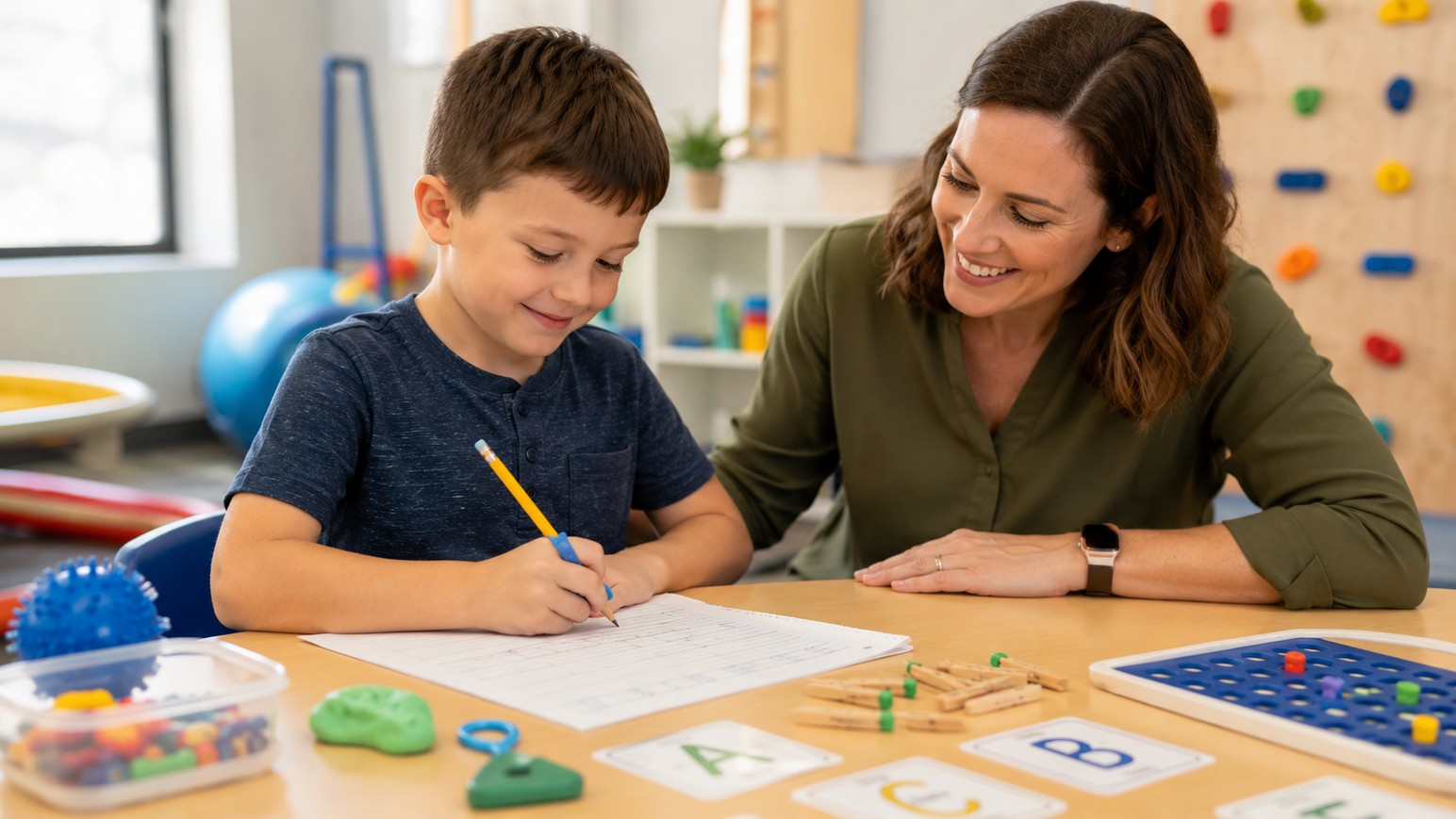
Learn why handwriting still supports focus, confidence, fine motor growth, and classroom success, plus how OT handwriting activities help children write with less stress.
Handwriting may look like a small school skill, but for many children it affects much more than the page in front of them. When writing is slow, messy, tiring, or frustrating, a child may avoid homework, rush through assignments, resist journaling, or struggle to show what they actually know. Parents may hear, “I hate writing,” when the deeper issue is not motivation but motor control, visual organization, hand strength, attention, or confidence.
Keyboards and tablets are useful tools, but they do not replace the developmental value of learning how to form letters, space words, organize thoughts, and build writing endurance. Penmanship still matters because handwriting connects the hand, eyes, body, and brain in a way that supports learning across subjects. This is where Occupational Therapy Handwriting Activities can make a meaningful difference, especially when the goal is not perfect handwriting but functional, comfortable, readable writing. WriteSteps approaches this support by focusing on useful handwriting skills that build school confidence and everyday participation.[]
Why Handwriting Still Has a Place in Learning
Handwriting is more than copying letters. It requires posture, shoulder stability, wrist control, finger strength, pencil grasp, visual tracking, memory, planning, and attention. A child must remember what a letter looks like, decide where it sits on the line, control the pencil, leave space between words, and keep writing long enough to finish the task.
When these pieces work together, handwriting becomes almost automatic. That automaticity matters because children can then focus on ideas instead of every pencil movement. When the process is not automatic, writing may take so much effort that spelling, sentence structure, creativity, and comprehension suffer.
For younger children, handwriting also builds readiness for classroom routines. They write their names, label pictures, complete worksheets, answer short questions, and begin organizing thoughts on paper. For older children, handwriting supports note-taking, test responses, planning, and written expression. Even when technology is available, children still need flexible writing skills for school, daily tasks, and confidence.
What Penmanship Challenges Can Look Like
Parents often notice handwriting problems before they understand the cause. A child may press too hard, hold the pencil awkwardly, write letters in different sizes, reverse letters, ignore margins, or complain that the hand hurts. Some children take a long time to finish simple written work. Others write quickly but produce work that teachers cannot easily read.
In many cases, the challenge is not laziness. A child may be working extremely hard, but the physical and visual demands of handwriting are too high. Weak hand muscles can make pencil control difficult. Poor core or shoulder stability can affect sitting posture and endurance. Visual perceptual challenges can make spacing, alignment, and letter placement harder. Sensory differences may cause a child to press too heavily, seek extra movement, or become distracted during tabletop tasks.
This is why families searching for handwriting kids San Diego support often need more than a worksheet packet. They need a closer look at the underlying skills that make handwriting easier or harder for a child.
How Occupational Therapy Handwriting Activities Help
Occupational Therapy Handwriting Activities are designed to build the foundation beneath writing, not just correct the final product. Instead of repeatedly telling a child to “write neater,” occupational therapy looks at why writing is difficult and builds skills through structured, child-friendly practice.
A session may include activities that strengthen the hands and fingers, such as using tongs, therapy putty, small manipulatives, clothespins, or games that require precise finger movements. These activities support pencil control without making the child feel like they are doing repetitive writing drills.
Children may also work on body positioning, shoulder stability, and bilateral coordination. These skills help them sit comfortably, stabilize the paper with one hand, and move the writing hand with better control. When the body is more stable, the fingers can do their job more effectively.
Visual motor activities are also important. A child may trace shapes, copy patterns, build letters with multisensory materials, use lined paper strategies, or practice spacing with visual cues. These tasks help the eyes and hands work together so letters are easier to form and organize.
For families exploring specialized pediatric occupational therapy services, the key is that therapy should feel practical. The goal is not to create picture-perfect handwriting. The goal is to help the child write clearly enough, comfortably enough, and efficiently enough to participate in school and daily life. WriteSteps also emphasizes progress that carries over into school tasks and home routines, not pressure for perfect penmanship.
The Real Problem: Writing Can Affect Confidence
Handwriting struggles can slowly shape how a child sees themselves as a learner. A bright child may avoid written assignments because the physical act of writing is exhausting. A creative child may write only a few words because getting ideas onto paper takes too much effort. A child who receives repeated corrections may begin to believe they are “bad at school,” even when the issue is skill-based and treatable.
This emotional side matters. Children notice when their work looks different from classmates’ work. They notice when they are the last to finish. They may become embarrassed when teachers ask them to rewrite assignments or when parents ask them to slow down. Over time, writing can become a source of stress instead of a tool for expression.
Supportive handwriting therapy helps shift the experience. When children understand that their hands, eyes, and body can be trained, writing becomes less mysterious and less frustrating. Small wins, such as forming letters more consistently, using spaces, finishing a sentence without hand fatigue, or copying from the board with better accuracy, can rebuild confidence.
Practical Strategies That Support Better Handwriting
Improving handwriting usually starts with observation. Is the child sitting with support? Is the paper positioned well? Is the pencil too thin, too short, or difficult to control? Is the child rushing because writing is uncomfortable? Is spacing the main issue, or is letter formation the bigger challenge?
Simple adjustments can help. A slanted writing surface may improve wrist position. Short writing sessions with movement breaks may reduce fatigue. Visual cues can help with letter size and spacing. Multisensory practice, such as forming letters in sand, using chalk, or building letters with clay, can make letter learning more memorable.
It also helps to separate handwriting practice from idea generation. If a child is learning to write a paragraph, they may need help planning ideas before being expected to write everything neatly. When the brain is managing content, spelling, punctuation, and pencil control all at once, the task can become overwhelming. Breaking the process into smaller steps often leads to better outcomes.
Parents looking for handwriting children San Diego support can also benefit from learning what to practice at home and what to leave for therapy sessions. Too much correction at home can create resistance. Short, positive, targeted practice is usually more helpful than long handwriting battles.[]
Real-World Examples of Handwriting Growth
Consider a child who writes with large, uneven letters and no spacing. The first step may not be writing full sentences. It may be building awareness of word boundaries using blocks, finger spaces, highlighted paper, or verbal rhythm. Once spacing improves, the child’s work becomes easier to read, and the teacher can focus more on content.
Another child may complain of hand pain after a few lines. In that case, the focus may include hand strengthening, pencil pressure control, posture, and endurance. The child may gradually move from short writing tasks to longer classroom-style assignments.
A third child may know the answer but avoid written responses. Therapy may combine movement, fine motor warm-ups, letter formation practice, and confidence-building writing tasks. The outcome is not just better penmanship. It is better participation.
For more parent-friendly guidance, the pediatric OT can be a helpful place to explore topics related to handwriting, fine motor skills, sensory processing, and learning development.
Benefits of Stronger Handwriting Skills
When handwriting becomes easier, children often experience benefits beyond neater letters. They may complete schoolwork with less frustration, write longer responses, show more pride in their work, and participate more fully in classroom tasks. Improved pencil control can also support related activities such as drawing, coloring, cutting, and craft projects.
Better handwriting can reduce the daily tension between parents and children during homework. Instead of constant reminders to “write better,” families can use specific strategies that match the child’s needs. Teachers may also get a clearer picture of what the child understands when handwriting no longer hides their knowledge.
Occupational Therapy Handwriting Activities are most effective when they connect to real life. Children need skills that carry over into worksheets, journals, spelling tests, birthday cards, classroom notes, and creative writing. Functional progress is the real measure of success.
When to Seek Support
Some handwriting variation is normal as children develop. However, support may be helpful if a child consistently avoids writing, has frequent hand fatigue, struggles to keep letters on the line, writes much more slowly than peers, reverses letters beyond the expected age range, presses too hard, or becomes upset during writing tasks.
For families searching for handwriting San Diego services, a pediatric occupational therapy evaluation can help identify whether the difficulty is related to fine motor skills, visual motor integration, sensory processing, posture, attention, or another underlying factor. Early support can prevent writing struggles from becoming a long-term source of stress.
Parents who are unsure where to begin can reach out to WriteSteps and ask what type of support may fit their child’s needs.
FAQs
Why does handwriting still matter if children use computers?
Handwriting still matters because it supports fine motor development, visual organization, attention, and classroom participation. Even when children use technology, they still need to write for school tasks, planning, labeling, note-taking, and everyday communication. The goal is not rejecting technology but helping children develop flexible skills.
What are common signs of handwriting difficulties?
Common signs include messy or uneven letters, poor spacing, hand fatigue, slow writing speed, awkward pencil grasp, letter reversals, heavy pencil pressure, and frustration during homework. Some children also avoid writing tasks or give very short answers because writing feels physically or mentally difficult.
How can occupational therapy improve handwriting?
Occupational therapy looks at the skills behind handwriting, including hand strength, posture, pencil control, visual motor coordination, sensory regulation, and endurance. Therapy uses targeted activities to build these foundations so writing becomes more comfortable, readable, and useful in real classroom situations.
Are handwriting worksheets enough?
Worksheets may help some children practice, but they are not always enough. If a child lacks hand strength, visual organization, body stability, or pencil control, repeated worksheets can increase frustration. A better approach identifies the root cause and uses activities matched to the child’s needs.
At what age should parents worry about handwriting?
Parents should look for patterns rather than one bad writing sample. If a child consistently avoids writing, complains of pain, cannot keep up with peers, or becomes upset during written work, it may be worth asking for guidance. Early support can make writing feel less stressful.
Can handwriting activities help with school confidence?
Yes. When writing becomes easier, children often feel more capable during classroom work and homework. Improved handwriting can help them finish assignments, express ideas more clearly, and feel less embarrassed about written work. Confidence grows when children experience steady, practical progress.
Wondering if OT could help your child?
Schedule a complimentary phone screening with Danielle — no pressure, just a conversation.
Book a screening